
Commercial Cleaning vs In-House Cleaning: Which Is Better?
- Servloop Team

- Jun 27
- 4 min read
A clean workplace serves as more than just a reflection of your business; it significantly influences employee productivity, customer confidence, workplace safety, and overall brand reputation. Regardless of whether you oversee a small office, retail store, warehouse, medical clinic, or a large commercial facility, it is imperative to uphold a hygienic environment to ensure the smooth functioning of daily operations.
One of the biggest decisions business owners face is whether to hire a commercial cleaning company or build an in-house cleaning team. At first glance, employing your own cleaner may seem like the more affordable option. However, once you consider wages, superannuation, equipment, training, insurance, leave entitlements, and management time, the picture often changes.
When considering leave entitlements and management time, the dynamics frequently shift. Conversely, outsourcing to a professional commercial cleaning company offers several advantages, including access to trained personnel, commercial-grade equipment, flexible scheduling, and predictable service costs—eliminating the need to manage cleaning staff directly.
So, which option offers the best value for your business?
In this comprehensive guide, we will compare commercial cleaning services with in-house cleaning based on several key factors: cost, quality, flexibility, compliance, scalability, and long-term return on investment. This analysis aims to assist you in making an informed decision for your business in Australia.
Understanding Commercial Cleaning

Commercial cleaning encompasses professional cleaning services provided by specialized companies. Unlike domestic cleaning, which focuses on residential spaces, commercial cleaning targets workplaces and business environments where cleanliness, hygiene, and regulatory compliance are of paramount importance.
Professional cleaning providers typically supply:
Fully trained cleaning staff
Commercial-grade equipment
Eco-friendly cleaning products
Insurance coverage
Flexible cleaning schedules
Quality control inspections
Depending on your business, commercial cleaning services may include:
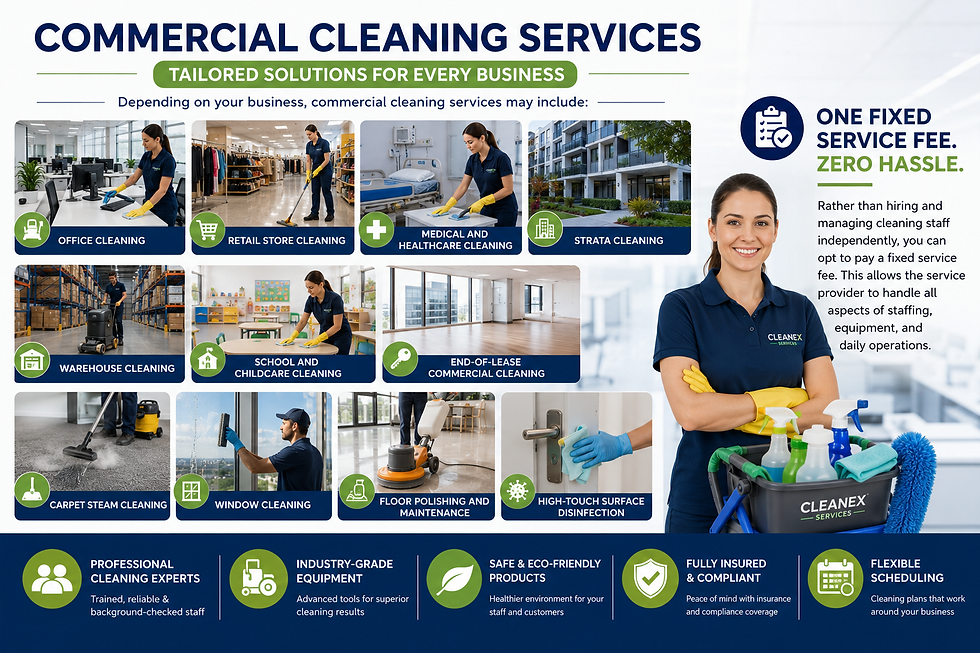
Office cleaning
Retail store cleaning
Medical and healthcare cleaning
Strata cleaning
Warehouse cleaning
School and childcare cleaning
End-of-lease commercial cleaning
Carpet steam cleaning
Window cleaning
Floor polishing and maintenance
High-touch surface disinfection
Rather than hiring and managing cleaning staff independently, you can opt to pay a fixed service fee. This allows the service provider to handle all aspects of staffing, equipment, and daily operations.
What Is In-House Cleaning?

In-house cleaning involves directly employing cleaners as part of your organization. This arrangement places the responsibility for recruiting, training, supervising, and managing the cleaning team squarely on your business.
An in-house cleaning program usually involves:
Hiring employees
Payroll processing
Superannuation contributions
Leave management
Purchasing cleaning chemicals
Buying equipment
Equipment maintenance
Workplace health and safety training
Staff performance reviews
Scheduling and rostering
While this approach offers enhanced control over daily operations, it also necessitates considerable administrative effort and ongoing operational expenses.
Commercial Cleaning vs In-House Cleaning: Quick Comparison
Feature | Commercial Cleaning | In-House Cleaning |
Initial Investment | Low | High |
Cleaning Equipment | Included | Business Purchases Equipment |
Staff Recruitment | Cleaning Company | Business Responsibility |
Insurance | Included | Employer Pays |
Staff Replacement | Included | Business Arranges Cover |
Flexibility | High | Moderate |
Training | Professional & Ongoing | Managed Internally |
Cost Predictability | Fixed Contract | Variable Expenses |
Management Time | Minimal | Significant |
Upon reviewing the comparison above, it is evident that commercial cleaning substantially alleviates the administrative burden on businesses, while simultaneously providing access to professional expertise and specialized equipment.
Cost Comparison: Which Option Saves More Money?
Many business owners operate under the assumption that hiring an employee is more cost-effective than outsourcing. Although the hourly wage for an in-house cleaner may seem lower, the overall expense associated with employing a full-time staff member often proves to be significantly higher.
When hiring an employee, businesses must consider expenses beyond wages, including:
Superannuation
Annual leave
Sick leave
Payroll administration
Workers' compensation insurance
Uniforms
Recruitment costs
Staff training
Cleaning equipment
Cleaning chemicals
Equipment maintenance
Replacement staff during leave
These hidden costs can substantially increase your annual cleaning budget.
With commercial cleaning services, most expenses are typically encompassed within the service agreement. This arrangement allows businesses to receive a predictable monthly invoice, alleviating concerns related to recruitment, absenteeism, equipment malfunctions, or additional employment costs.
For growing businesses, this predictability makes budgeting significantly easier.
Cleaning Quality and Professional Standards
Maintaining consistent cleaning standards requires experience, proper training, and quality control procedures.
Professional commercial cleaning companies typically adhere to structured cleaning checklists and implement regular inspection protocols to ensure that all tasks meet industry standards. Their teams are trained to properly utilize commercial-grade equipment, apply appropriate cleaning techniques for various surfaces, and minimize the risk of cross-contamination.
In contrast, the effectiveness of an in-house cleaning team frequently hinges on the individual experience of its members and the level of internal oversight. When employees depart the organization or new hires enter without sufficient training, the consistency of cleaning standards can suffer significantly.
For businesses in sectors such as healthcare, hospitality, childcare, and food services, upholding consistent hygiene standards is of paramount importance. Professional cleaning providers are typically better equipped to meet these rigorous expectations, thanks to ongoing staff training and well-established quality assurance systems.
Frequently Asked Questions (FAQs)
1. Is commercial cleaning more cost-effective than hiring an in-house cleaning team?
In many cases, yes. Commercial cleaning companies provide trained staff, cleaning equipment, supplies, insurance, and replacement cleaners as part of their service. With an in-house team, businesses must also cover wages, superannuation, leave entitlements, training, equipment, and ongoing management costs, which can increase the overall expense.
2. What is the main difference between commercial cleaning and in-house cleaning?
The main difference is who manages the cleaning staff. Commercial cleaning is outsourced to a professional cleaning company that handles recruitment, training, supervision, and equipment. In-house cleaning involves employing and managing your own cleaning staff within the organisation.
3. Which option provides better cleaning quality?
Professional commercial cleaning companies generally deliver more consistent results because their staff receive specialised training, follow structured cleaning checklists, and use commercial-grade equipment. However, a well-managed in-house team can also maintain high standards with proper supervision and ongoing training.
4. Which businesses benefit most from commercial cleaning services?
Commercial cleaning is ideal for offices, retail stores, medical clinics, schools, warehouses, hospitality venues, strata properties, and other businesses that require consistent, professional cleaning and flexible service schedules.
5. Do commercial cleaning companies provide their own cleaning equipment and supplies?
Yes. Most commercial cleaning companies supply their own professional-grade equipment, cleaning chemicals, and tools. This eliminates the need for businesses to purchase, maintain, and replace cleaning equipment.


Comments